SYSTEMS & METHODS FOR PERSISTENT WORLD-STATE COMPILATION, CONFIDENCE-AWARE COMPUTATIONAL AUTHORITY, PREDICTIVE VISIBILITY PROCESSING, SELECTIVE GENERATIVE RENDERING, & GENERATIVE KNOWLEDGE ACQUISITION

PROVISIONAL PATENT APPLICATION
INVENTOR: ALI DARESHOORI
09/07/2027
SYSTEMS AND METHODS FOR PERSISTENT WORLD-STATE COMPILATION, CONFIDENCE-AWARE COMPUTATIONAL AUTHORITY, PREDICTIVE VISIBILITY PROCESSING, SELECTIVE GENERATIVE RENDERING, AND GENERATIVE KNOWLEDGE ACQUISITION
INVENTOR INFORMATION
Inventor(s):[INSERT LEGAL NAME]
Residence:[INSERT CITY, STATE, COUNTRY]
Correspondence Address:[INSERT]
Date:[INSERT FILING DATE]
1. TECHNICAL FIELD
The present disclosure relates generally to computer graphics, artificial intelligence, machine learning, computer vision, spatial computing, rendering, image generation, video generation, interactive digital environments, simulation, virtual production, gaming, robotics, digital twins, extended reality, and persistent machine-readable scene representation.
More particularly, the disclosure relates to computer systems that maintain persistent representations of a world independently of individual generative inference operations, determine what information concerning that world is sufficiently known for a requested observation, selectively allocate computational responsibility among available execution mechanisms, acquire additional information when necessary, and reuse previously established world information across subsequent observations.
2. BACKGROUND
Many generative image, video, and world-generation systems repeatedly perform computationally expensive inference over information that was substantially established during prior processing.
For example, a wall, floor, character identity, object geometry, or lighting arrangement may remain substantially unchanged between successive requested viewpoints while a generative process nevertheless performs substantial processing over those same elements.
Such repeated inference may result in:
increased processing latency;
increased accelerator utilization;
increased memory and bandwidth usage;
increased network communication;
redundant reconstruction;
higher computational cost;
temporal inconsistency;
geometry drift;
identity drift;
appearance drift;
mutation of previously established scene information.
Conventional graphics systems can maintain persistent explicit scene state but generally require scene information to already exist.
Generative systems may acquire missing information but may treat generated results primarily as disposable frames or outputs rather than as persistent structured world knowledge.
A need therefore exists for an architecture that combines persistent world state with selective generative acquisition while reducing redundant computation.
3. SUMMARY
A computer-implemented system maintains a persistent canonical representation of a digital, reconstructed, simulated, or partially generated world.
The persistent world state may contain information describing:
persistent entities;
geometry or spatial representations;
spatial transforms;
identity;
appearance;
materials;
physical or motion state;
temporal state;
provenance;
dependencies;
confidence or uncertainty;
validation status;
historical state;
representation alternatives.
For a requested observation, the system determines which required information is already sufficiently represented.
Where sufficient information exists, the system may use one or more lower-cost or deterministic computational mechanisms including:
reuse;
cached state;
reprojection;
geometric rendering;
procedural computation;
simulation;
physical computation;
interpolation;
reconstruction.
Where information is not sufficiently represented, the system may selectively invoke one or more machine-learning or generative inference mechanisms.
Accepted newly acquired information may be associated with persistent world coordinates, persistent entities, or other persistent world state and reused during later observations.
Future viewpoints may additionally be analyzed before they occur to identify world information expected to become visible but not yet sufficiently represented.
4. CENTRAL ARCHITECTURAL PRINCIPLE
The persistent world state is maintained independently from an individual generative model.
One or more generative models may operate as replaceable computational mechanisms for acquiring unresolved world information.
Thus, world identity, geometry, history, state, provenance, confidence, and other persistent information need not exist solely inside the internal state of a particular generative model.
A first model may therefore be replaced by a second model while retaining previously established world information.
5. CANONICAL WORLD STATE
In an embodiment, the system maintains world state:
Wt={E,G,X,A,M,Q,P,D,H,R,C}W_t=\{E,G,X,A,M,Q,P,D,H,R,C\}
where, by way of example:
EE represents persistent entities;
GG represents geometry or spatial representation;
XX represents transforms and spatial relationships;
AA represents appearance information;
MM represents dynamic, physical, or motion state;
QQ represents confidence, uncertainty, or epistemic state;
PP represents provenance;
DD represents dependencies;
HH represents history;
RR represents representation information;
CC represents constraints.
The foregoing notation is illustrative and does not require use of the listed variables or a particular data format.
6. PERSISTENT ENTITIES
A world entity may include any combination of:
persistent identifier;
semantic type;
parent or child relationships;
position;
orientation;
scale;
geometry;
bounding information;
representation type;
material;
texture;
appearance reference;
motion state;
physical state;
observed regions;
inferred regions;
generated regions;
confidence state;
provenance;
validation state;
dependencies;
identity fingerprint;
lock state;
version;
history.
Persistent entity identity may remain stable across frames, viewpoints, model calls, sessions, devices, or changes in underlying generative model.
7. SPATIAL STATE
An entity may have a transform:
Ti(t)T_i(t)
mapping information between local and world coordinates.
For example:
Xworld=Ti(t)XlocalX_{world}=T_i(t)X_{local}
and for a camera having transform Tc(t)T_c(t):
Xcamera=Tc(t)−1Xworld.X_{camera}=T_c(t)^{-1}X_{world}.
The invention is not restricted to a particular coordinate system, projection method, scene representation, or spatial data structure.
8. WORLD DELTAS AND TRANSACTIONS
Instead of recreating the entire world after every modification, state changes may be represented as changesets:
Wt+1=Apply(Wt,ΔWt).W_{t+1}=Apply(W_t,\Delta W_t).
A changeset may include operations such as:
ADD;
MODIFY;
MOVE;
DELETE;
LOCK;
UNLOCK;
PROMOTE;
DEMOTE;
INVALIDATE;
REPLACE;
ASSIGN REPRESENTATION.
World information unaffected by the transaction may remain unchanged.
9. EPISTEMIC OR CONFIDENCE STATE
Persistent world information may include an indication of whether the information is:
directly observed;
reconstructed;
inferred;
generated;
predicted;
corroborated;
validated;
contradicted;
uncertain;
unknown.
One example embodiment associates a confidence value:
Q(x)∈[0,1].Q(x)\in[0,1].
The confidence representation may alternatively be:
categorical;
probabilistic;
vector-valued;
distributed;
Bayesian;
evidence-based;
learned;
another machine-readable sufficiency representation.
The invention does not depend upon a specific numeric threshold.
10. COMPUTATIONAL AUTHORITY
For a region, entity, property, or other world element relevant to a requested observation, a computational authority controller determines which execution mechanism should produce the required result.
Possible execution authorities include:
reuse;
cache;
historical reprojection;
geometric rendering;
procedural computation;
animation;
physics;
simulation;
reconstruction;
neural rendering;
generative inference;
combinations thereof.
Authority may be selected according to one or more of:
information sufficiency;
confidence;
uncertainty;
visibility;
future visibility;
temporal change;
dependency state;
available representation;
requested fidelity;
latency;
hardware availability;
compute budget;
memory;
importance.
A general authority relationship may be expressed as:
A(r,t)=f(Q,V,Δ,D,R,F,C,H)A(r,t)=f(Q,V,\Delta,D,R,F,C,H)
where the particular function ff is implementation dependent.
The system may use deterministic rules, probability, optimization, learned policies, machine learning, or combinations thereof.
11. EXAMPLE COMPUTE PRIORITY
One illustrative embodiment may prioritize processing according to:
P(x,t)=Visibility(x,t)(1−Q(x))Δ(x,t).P(x,t)=Visibility(x,t)(1-Q(x))\Delta(x,t).
The relationship represents the principle of prioritizing information that:
is relevant to an observation;
is not sufficiently known;
has changed or requires new processing.
This equation is illustrative only.
Alternative relationships, variables, thresholds, or policies may be used.
12. CURRENT AND FUTURE VISIBILITY
The system may calculate which world regions are visible from a requested observation.
It may additionally evaluate future or predicted observations.
A future observation may be based upon:
a predetermined camera path;
predicted camera motion;
user navigation;
head movement;
gaze;
player movement;
robot motion;
simulation;
scripted cinematography.
If a future viewpoint is C(t+Δ)C(t+\Delta), the system may identify regions expected to become visible.
13. DISOCCLUSION FRONTIER
A future viewpoint may reveal world information not previously observed or sufficiently represented.
A conceptual unresolved set may be expressed as:
U=FutureVisible(C)−SufficientlyKnown(W).U= FutureVisible(C) - SufficientlyKnown(W).
The system may identify such information before it becomes immediately visible.
The unresolved set may be referred to as a future unresolved region, visibility deficit, spatial prefetch frontier, or disocclusion frontier.
14. PREDICTIVE ACQUISITION
A future unresolved region may be processed prior to becoming visible.
Processing may include:
retrieval;
reconstruction;
geometric completion;
procedural construction;
generative inference;
another acquisition mechanism.
Priority may depend upon:
probability of future visibility;
time until visibility;
predicted display area;
confidence;
requested quality;
importance;
compute availability;
latency.
15. GENERATIVE KNOWLEDGE ACQUISITION
Generative inference output may be treated as candidate world information rather than only as transient output.
For example, a generated previously unseen surface may be associated with:
a persistent entity;
spatial coordinates;
geometry;
appearance;
provenance;
source model;
confidence state;
validation state.
Conceptually:
Generation→CandidateWorldKnowledge.Generation \rightarrow CandidateWorldKnowledge.
After validation:
CandidateWorldKnowledge→PersistentWorldKnowledge.CandidateWorldKnowledge \rightarrow PersistentWorldKnowledge.
Subsequent observations may reuse the resulting information.
16. KNOWLEDGE PROMOTION AND DEMOTION
Generated or inferred information may transition among states such as:
UNKNOWN
→ CANDIDATE
→ GENERATED
→ CORROBORATED
→ VERIFIED
→ LOCKED.
Additional evidence may increase confidence.
Contradictory evidence may cause:
confidence reduction;
demotion;
invalidation;
replacement;
branching;
additional acquisition.
Only affected state need be changed.
17. VALIDATION
Candidate world information may be validated using one or more of:
geometric consistency;
depth consistency;
camera consistency;
multi-view consistency;
identity consistency;
material consistency;
temporal consistency;
motion consistency;
physical constraints;
reference comparison;
fingerprints;
embeddings;
model agreement;
human validation.
Candidate information may be:
fully accepted;
partially accepted;
rejected.
Partial rejection allows unaffected world information to remain unchanged.
18. DEPENDENCY-AWARE INVALIDATION
Persistent world information may include dependency relationships.
For example, changing an object's location may affect:
shadow;
reflection;
occlusion;
motion vectors.
The same change may not affect unrelated geometry or distant objects.
When state changes, only dependent information may require reevaluation.
19. HETEROGENEOUS REPRESENTATIONS
Different portions of the same world may use different representations.
Examples include:
polygon geometry;
procedural geometry;
point clouds;
Gaussian representations;
neural representations;
layered depth;
volumes;
articulated models;
cached imagery;
generated representations.
A representation router may select an appropriate representation according to quality, cost, distance, editability, uncertainty, hardware, or other requirements.
Persistent entity identity may remain constant even where the selected representation changes.
20. BASE RENDER AND SELECTIVE NEURAL PROCESSING
Known world information may first produce a base observation through deterministic or semi-deterministic execution.
The system may generate auxiliary information including:
RGB;
depth;
normals;
object identity;
material identity;
motion;
lighting;
confidence;
uncertainty;
unknown-region masks.
A subsequent neural process may selectively improve portions of the observation.
One illustrative formulation is:
It=(1−Mt)Ht+MtN(Ft)I_t=(1-M_t)H_t+M_tN(F_t)
where:
HtH_t represents known, historical, or base-rendered information;
MtM_t represents a selected processing mask;
NN represents a neural process;
FtF_t represents world-derived features.
The exact neural architecture is not limiting.
21. COMPUTATIONAL SPEED AND REDUCTION
A significant technical benefit of embodiments of the disclosed system is reduction in computation required for repeated world observation.
The system does not merely attempt to execute the same generative process faster.
Instead, it may eliminate or limit high-cost processing for information already sufficiently represented.
A baseline process may incur:
Cbase(N)=∑t=1NCgen(Ot).C_{base}(N)=\sum_{t=1}^{N}C_{gen}(O_t).
An embodiment of the disclosed system may instead incur:
Cpersistent(N)=Ccompile+∑t=1N[Creuse(t)+CΔ(t)+Cunknown(t)].C_{persistent}(N) = C_{compile} + \sum_{t=1}^{N} [ C_{reuse}(t) + C_{\Delta}(t) + C_{unknown}(t) ].
Where:
CcompileC_{compile} is world compilation cost;
CreuseC_{reuse} is reuse or deterministic rendering cost;
CΔC_{\Delta} represents changed-state processing;
CunknownC_{unknown} represents unresolved-information processing.
As world knowledge increases:
KnownWorld↑KnownWorld\uparrow
then:
NewInference↓NewInference\downarrow
may occur.
Potential resulting effects include:
Latency↓Latency\downarrow AcceleratorUse↓AcceleratorUse\downarrow MemoryTransfer↓MemoryTransfer\downarrow NetworkRequests↓NetworkRequests\downarrow ComputeCost↓.ComputeCost\downarrow.
22. COLD AND WARM WORLD EXECUTION
A relatively newly compiled world may require greater reconstruction or generation.
A world containing substantial previously acquired information may require less new processing.
Accordingly:
Twarm<TcoldT_{warm}<T_{cold}
may occur for equivalent or similar observation requests.
No specific performance ratio is required.
23. COMPUTE SKIPPING
The system may avoid execution when:
information is already sufficiently represented;
state has not changed;
dependencies remain valid;
the information is not currently visible;
the information is not predicted to be needed.
A Compute Skip Ratio may be measured as:
CSR=1−ExecutedWorkPotentialWork.CSR= 1- \frac{ExecutedWork}{PotentialWork}.
This metric is exemplary and non-limiting.
24. ACTIVE REGION PROCESSING
Only part of an observation may require high-cost processing.
An Active Region Fraction may be expressed as:
ARF=HighCostRegionTotalObservationRegion.ARF= \frac {HighCostRegion} {TotalObservationRegion}.
Where the active region is substantially less than the complete observation, high-cost inference may be restricted accordingly.
25. PERFORMANCE METRICS
The runtime may measure:
execution time;
neural calls;
accelerator time;
memory usage;
generated area;
reuse ratio;
active region fraction;
network requests;
time to frame;
repeat-render cost;
geometry drift;
identity drift;
temporal stability.
An exemplary Knowledge Reuse Ratio is:
KRR=ReusableWorldInformationWorldInformationRequired.KRR= \frac {ReusableWorldInformation} {WorldInformationRequired}.
An exemplary Neural Invention Fraction is:
NIF=InformationRequiringNewGenerativeInferenceTotalRequiredOutputInformation.NIF= \frac {InformationRequiringNewGenerativeInference} {TotalRequiredOutputInformation}.
26. FIRST-RUN AND REPEAT-RUN EMBODIMENT
A reference image depicts a static interior environment.
The system:
obtains spatial information from the reference;
constructs persistent world state;
assigns persistent identifiers;
receives a camera trajectory;
renders or reprojects known information;
identifies a newly exposed unknown region;
selectively requests completion of the unknown region;
validates the resulting candidate;
associates the accepted result with persistent world state;
renders the observation;
stores the updated world.
When the same or similar trajectory is subsequently requested, the previously acquired region may be reused rather than regenerated.
This demonstrates generative information becoming persistent reusable knowledge.
27. MODEL REPLACEMENT EMBODIMENT
A first generative model may be used to acquire information for a persistent world.
The model may later become unavailable or be replaced by a second generative model.
Previously validated world state remains available.
The second model may be used only for unresolved information subsequently encountered.
Thus:
ModelReplacement⇏WorldReplacement.ModelReplacement \not\Rightarrow WorldReplacement.
28. DISTRIBUTED EMBODIMENT
The persistent world system may execute:
locally;
remotely;
in cloud infrastructure;
at an edge device;
across multiple computing devices;
using combinations thereof.
For example:
world state and visibility analysis may occur locally;
expensive generative processing may occur remotely;
only selected unresolved context may be transmitted;
accepted results may return to persistent state.
29. AVAILABLE UNDERLYING COMPONENTS
The disclosed architecture does not require the inventor to create every underlying graphics, reconstruction, or machine-learning primitive from scratch.
Present or future technologies capable of performing operations including:
depth estimation;
segmentation;
camera estimation;
reconstruction;
tracking;
geometry processing;
rendering;
simulation;
generative completion;
image generation;
video generation;
super-resolution;
encoding
may be integrated through appropriate interfaces.
The invention concerns in part how such capabilities are coordinated with persistent world state, how unnecessary work is avoided, how computational authority is selected, and how newly acquired information becomes reusable state.
30. IMPLEMENTATION INDEPENDENCE
The disclosed system is not restricted to:
a particular programming language;
a particular scene-description format;
a particular graphics API;
a particular neural model;
a particular accelerator;
meshes;
Gaussian splats;
radiance fields;
a particular confidence equation.
Implementations may employ present or future equivalent technologies.
31. APPLICATIONS
Embodiments may be applied to:
video generation;
cinematography;
virtual production;
interactive digital worlds;
gaming;
augmented reality;
virtual reality;
mixed reality;
robotics;
simulation;
digital twins;
architecture;
advertising;
product visualization;
synthetic data;
industrial simulation;
spatial computing.
32. EXAMPLE COMPUTER-IMPLEMENTED METHOD
A method may comprise:
receiving an observation request;
accessing persistent canonical world state;
identifying world information required for the observation;
determining information sufficiency for one or more portions of the required world information;
determining visibility, change, dependency, representation, or combinations thereof;
selecting one or more computational mechanisms;
using non-generative processing where stored world information is sufficient;
selectively invoking generative inference for at least a portion of insufficiently represented information;
validating resulting candidate information;
associating accepted candidate information with persistent world state;
rendering or otherwise producing the requested observation;
reusing the associated information during at least one subsequent observation.
The listed operations may occur in different orders, concurrently, asynchronously, or in distributed systems.
33. CLAIM-CONCEPT SUPPORT
Subject matter contemplated as potentially inventive includes:
A.
Maintaining persistent world information independently of individual generative inference operations.
B.
Selecting computational authority according to information sufficiency or epistemic state.
C.
Restricting high-cost generative inference to unresolved world information.
D.
Predicting future visibility of unresolved information.
E.
Processing unresolved information before its future exposure.
F.
Mapping generative output into persistent world state for later reuse.
G.
Updating confidence of generated world knowledge using subsequent evidence.
H.
Selective invalidation based on dependencies.
I.
Sparse world-state transactions that leave unaffected state unchanged.
J.
Maintaining persistent world state across replacement of generative models.
K.
Selecting heterogeneous world representations while maintaining persistent entity identity.
L.
Reducing repeated computation through persistent accumulated world knowledge.
M.
Producing subsequent observations with reduced new generative processing relative to earlier observations.
34. DRAWINGS
The following drawings form part of this disclosure:
FIG. 1 — overall persistent world execution architecture.
FIG. 2 — canonical persistent world entity structure.
FIG. 3 — multimodal input to world compilation.
FIG. 4 — sparse world-state changeset.
FIG. 5 — epistemic/confidence state transitions.
FIG. 6 — current and future camera frusta.
FIG. 7 — disocclusion frontier.
FIG. 8 — computational authority selection.
FIG. 9 — heterogeneous representation routing.
FIG. 10 — generated surface acquisition.
FIG. 11 — generated knowledge promotion.
FIG. 12 — dependency graph and selective invalidation.
FIG. 13 — base render with selective neural processing.
FIG. 14 — model adapter and model replacement architecture.
FIG. 15 — first-run acquisition and second-run reuse.
FIG. 16 — distributed local/cloud execution.
FIG. 17 — performance instrumentation.
FIG. 18 — probabilistic future-view prefetch.
FIG. 19 — baseline frame-centric versus persistent-world computation.
FIG. 20 — cold-world versus warm-world execution.
FIG. 21 — compile-cost amortization.
FIG. 22 — compute skip ratio.
FIG. 23 — neural-compute and active-region fractions.
FIG. 24 — predictive processing before a future deadline.
FIG. 25 — canonical versus derived state.
FIG. 26 — ephemeral cache versus persistent knowledge.
FIG. 27 — evidence and contradiction graph.
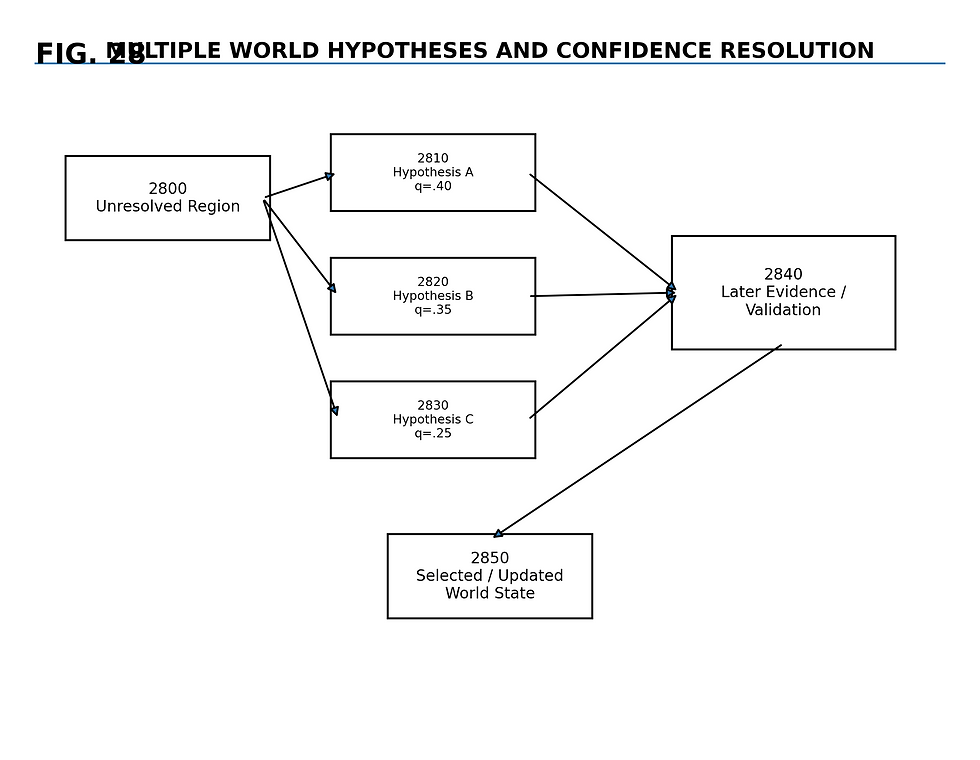
FIG. 28 — alternative hypotheses and confidence resolution.
FIG. 29 — local/cloud authority routing.
FIG. 30 — representation changes according to fidelity or distance.
FIG. 31 — graceful degradation under limited computation.
FIG. 32 — adaptive execution-policy feedback.
FIG. 33 — repeat-render acceleration benchmark.
FIG. 34 — partitioned and streamed world execution.
FIG. 35 — limited-context remote generation.
FIG. 36 — multi-user transaction conflict resolution.
35. ABSTRACT
Systems and methods are disclosed for executing persistent digital worlds using selective generative computation. A canonical world state stores persistent spatial, identity, appearance, temporal, provenance, dependency, representation, and confidence information independently of individual generative models. For a requested observation, the system determines which required world information is sufficiently represented and selectively assigns portions of the observation to reuse, geometric rendering, procedural computation, physical simulation, reconstruction, or generative inference. Future viewpoints may be evaluated to identify information expected to become visible but not sufficiently represented. Generated information may be validated, associated with persistent world coordinates or entities, and subsequently reused rather than repeatedly regenerated. Changes may be represented as sparse world-state transactions while unaffected state remains persistent. The architecture may thereby reduce redundant computation, generative inference, processing latency, accelerator utilization, memory transfer, and network communication while improving spatial, geometric, temporal, and identity consistency.
36. NON-LIMITING STATEMENT
The foregoing embodiments are illustrative and not limiting.
Functions described as separate modules may be combined.
Functions described as single modules may be distributed.
Operations may occur in alternative orders, simultaneously, asynchronously, locally, remotely, or in combinations thereof.
The disclosed invention is not limited to particular programming languages, graphics systems, artificial-intelligence architectures, spatial representations, hardware platforms, numerical thresholds, scoring functions, or named third-party technologies.
Equivalent present and subsequently developed technologies may be used to implement the disclosed persistent-world, computational-authority, predictive-visibility, selective-generation, validation, knowledge-promotion, and rendering functions.




FINAL PROVISIONAL COVERAGE ADDENDUM
The following embodiments, variations, and technical implementations supplement the disclosure and are intended to clarify that the disclosed persistent-world execution architecture is not limited to a particular spatial format, observation type, generative model, execution sequence, hardware platform, data representation, or computational granularity.
37. EXPLICIT, IMPLICIT, AND LATENT WORLD STATE
Persistent world state need not consist solely of conventional explicit three-dimensional geometry.
Persistent state may include:
explicit geometry;
implicit geometry;
latent representations;
neural representations;
embeddings;
tokens;
vectors;
feature fields;
probability fields;
occupancy fields;
signed distance fields;
radiance fields;
Gaussian representations;
point clouds;
graph structures;
semantic relationships;
compressed representations;
combinations thereof.
Accordingly, the persistent nature of world information does not depend upon a particular human-readable scene format.
The important property is that information representing previously established world state can survive individual inference operations and be used to answer subsequent observation requirements.
38. HIERARCHICAL GRANULARITY
Information sufficiency, confidence, computational authority, dependency, and validation may be evaluated at any useful granularity.
Examples include:
complete world;
scene;
zone;
entity;
object;
component;
surface;
polygon;
voxel;
point;
Gaussian;
texture region;
image tile;
pixel;
temporal segment;
feature;
token;
latent region;
semantic fact;
relationship.
Different granularities may coexist.
For example, identity may be tracked at entity level while uncertainty is tracked at surface level and neural processing is allocated at image-tile level.
39. NONVISUAL OBSERVATIONS
The term “observation” is not limited to an RGB image.
A requested observation may comprise:
depth;
normals;
segmentation;
optical flow;
lidar;
radar;
synthetic sensor measurements;
semantic information;
object state;
physical state;
occupancy;
collision information;
environmental information;
audio;
spatial audio;
metadata;
machine-readable state.
Thus the persistent world may answer requests from visual renderers, simulations, robots, autonomous systems, spatial interfaces, or other computing systems.
40. GENERATIVE OUTPUT NEED NOT BE PIXELS
Generative inference may produce or modify:
imagery;
geometry;
topology;
texture;
material;
animation;
motion;
physical parameters;
semantic information;
object relationships;
environmental state;
neural representation;
latent representation;
audio;
executable procedural information.
Such information may become persistent world knowledge.
41. COMPILER AND RUNTIME SEPARATION
An embodiment may comprise separate:
World Compiler
and
World Runtime.
The world compiler may transform input information into an initial reusable machine-readable world representation.
The runtime may thereafter:
receive observations;
process changes;
update state;
render observations;
acquire unresolved information;
validate additions;
incrementally compile new evidence.
World compilation may therefore occur:
once;
periodically;
incrementally;
continuously.
42. INCREMENTAL WORLD COMPILATION
New information may be incorporated without recompiling the complete world.
For example:
[
W_{n+1}
IncrementalCompile(W_n,E_{new})
]
where (E_{new}) represents newly available evidence.
Only affected world information and dependencies may require reevaluation.
43. EXECUTABLE WORLD ARTIFACT
World compilation may produce an executable or reusable world artifact.
Such artifact may include:
persistent IDs;
spatial state;
representations;
confidence;
provenance;
dependencies;
validation state;
cached knowledge;
temporal state;
constraints.
The artifact may be:
stored;
copied;
transmitted;
versioned;
streamed;
loaded by another device.
A proprietary or standard scene format may be used.
44. WORLD PACKAGE / WORLD CARTRIDGE
A reusable compiled world may be packaged as a machine-readable world package.
A world package may contain canonical and derived information.
The package may be portable between:
applications;
machines;
renderers;
models;
users;
computing environments.
The invention does not depend upon any specific package name, file extension, or storage format.
45. CANONICAL STATE AND DERIVED STATE
The runtime may distinguish:
Canonical world state
Authoritative persistent information.
from:
Derived computational state
Information calculated from canonical state.
Derived state may include:
shadows;
reflections;
visibility sets;
rendered images;
acceleration structures;
temporary model features;
motion buffers;
neural residuals.
Changing derived state need not modify canonical state.
46. EPHEMERAL CACHE AND PERSISTENT KNOWLEDGE
The system may distinguish between:
temporary computational cache
and:
persistent reusable knowledge.
Temporary information may be retained only for near-term execution.
Where appropriate, temporary information may later be validated and promoted into persistent state.
47. MULTILEVEL CACHE HIERARCHY
Caching may occur at:
frame level;
tile level;
surface level;
object level;
scene level;
representation level;
feature level;
model-result level;
world level.
Each cache may have independent validity criteria.
48. MULTIPLE WORLD HYPOTHESES
Insufficiently observed information need not immediately be represented as a single presumed fact.
The system may maintain:
[
H_1,H_2,\ldots,H_n
]
representing alternative hypotheses concerning a world element.
Each hypothesis may have:
confidence;
provenance;
evidence;
constraints;
model source.
Future evidence may:
select;
merge;
reject;
modify;
rerank
the alternatives.
49. CONTRADICTION MANAGEMENT
When new information conflicts with persistent world state, the system may create a machine-readable contradiction record.
The contradiction record may identify:
existing state;
new evidence;
source;
confidence;
affected region;
dependencies;
resolution status.
Contradictions may therefore be resolved locally rather than causing complete world reconstruction.
50. ACTIVE OBSERVATION AND ACTIVE SENSING
The system may determine that additional observation is preferable to generative inference.
For example, where information confidence is insufficient, the system may:
request another image;
request another camera angle;
move a virtual camera;
move a physical camera;
alter robot trajectory;
activate a sensor;
request user confirmation.
Thus unresolved world information may be acquired through additional observation rather than generated.
51. UNCERTAINTY-REDUCING VIEWPOINT SELECTION
A system may select a future observation partly to reduce uncertainty.
A viewpoint may be selected according to:
[
C^*
\arg\max_C
InformationGain(C).
]
The exact information-gain function is implementation dependent.
This embodiment is useful in:
robotics;
inspection;
digital twins;
reconstruction;
autonomous systems.
52. SEMANTIC WORLD STATE
Persistent state may contain nongeometric information.
Examples include:
entity class;
ownership;
functional relationships;
scene roles;
identity;
permissions;
constraints;
expected behavior.
Semantic state may constrain future processing.
53. CAUSAL WORLD STATE
Persistent world state may include causal relationships.
For example:
switch A controls light B.
Opening valve C changes fluid flow D.
Moving object E changes occlusion F.
Where a causal relationship is known, resulting state may be calculated rather than rediscovered through generative inference.
54. CONSTRAINT PROPAGATION
World constraints may propagate through relationships.
Example:
a product has locked geometry.
Therefore:
silhouette must remain consistent;
generated texture must align with the geometry;
neural modification may be restricted.
Constraints may reduce the search space presented to high-cost computational mechanisms.
55. EVENT-DRIVEN EXECUTION
The runtime may operate in response to events including:
CAMERA_MOVED;
OBJECT_MOVED;
WORLD_UPDATED;
LIGHT_CHANGED;
SURFACE_REVEALED;
UNKNOWN_DETECTED;
GENERATION_ACCEPTED;
EVIDENCE_CONTRADICTED;
REPRESENTATION_CHANGED.
Only computational modules affected by an event need execute.
56. TIME AS FIRST-CLASS WORLD STATE
The world may maintain a shared temporal reference.
Dynamic entity state may be expressed as:
[
S_i(t).
]
Camera, actors, lights, physics, environment, audio, and other state may reference the same timeline.
This can preserve cross-system temporal consistency.
57. SCHEDULED AND DEADLINE-AWARE EXECUTION
An unresolved region may have a predicted time until required:
[
d(r)=t_{required}-t_{current}.
]
The runtime may schedule processing according to the deadline.
Work having a later deadline may be deferred.
Work predicted to become visible soon may receive increased priority.
58. IDLE-COMPUTE UTILIZATION
Predictive processing may be performed during otherwise underutilized computational periods.
For example:
current observation rendered;
accelerator becomes partially available;
future unresolved region is processed;
result becomes available before the future camera reaches that region.
This can reduce critical-path latency.
59. COMPUTATIONAL BUDGETING
Authority selection may consider a resource budget including:
maximum latency;
accelerator time;
memory;
power;
monetary cost;
bandwidth;
output-quality requirement.
Different execution mechanisms may be selected for different resource constraints.
60. ENERGY-AWARE EXECUTION
On constrained devices, authority selection may consider power consumption.
A mobile or battery-powered device may therefore select a lower-energy representation or computational path while retaining the same persistent world identity.
61. COST-AWARE EXECUTION
Where remote computational services have different monetary costs, the runtime may consider cost in determining whether, when, or where a computational operation should execute.
No particular pricing model is required.
62. QUALITY-OF-SERVICE MODES
The system may operate using different quality modes.
Examples:
low-latency preview;
interactive;
balanced;
final render;
archival fidelity.
Persistent world state may remain common across the modes.
63. PROGRESSIVE REPRESENTATION QUALITY
A persistent entity may be represented at varying levels of fidelity.
For example:
far away:
simplified representation.
near camera:
high-resolution representation.
hero view:
maximum-quality representation.
Entity identity remains unchanged across levels.
64. HARDWARE-AWARE ROUTING
Computational authority may depend on hardware availability.
Example devices include:
CPU;
GPU;
NPU;
TPU;
AI accelerator;
graphics accelerator;
custom hardware;
edge processor.
A first device may select a different computational implementation from a second device while using the same persistent world state.
65. FUTURE HARDWARE COMPATIBILITY
The disclosed architecture is not limited to hardware available on the filing date.
Future accelerators or specialized world-processing hardware may implement one or more portions of the architecture.
66. HARDWARE / SOFTWARE CO-DESIGN
Some functions may be implemented directly in hardware, firmware, software, or combinations thereof.
Potential hardware-accelerated operations include:
visibility determination;
world-state lookup;
uncertainty lookup;
dependency traversal;
representation selection;
cache lookup;
spatial projection;
generative inference.
67. PARTITIONED WORLD EXECUTION
Large worlds may be divided into partitions.
Partitions may be based upon:
spatial area;
scene;
semantic grouping;
visibility;
application.
Only relevant partitions need reside in active memory.
68. STREAMING WORLD STATE
A complete world need not be loaded before producing an observation.
Relevant persistent information may be streamed based upon:
current viewpoint;
future viewpoint;
probability of use;
dependency requirements.
This can reduce startup latency and memory use.
69. DISTRIBUTED WORLD STATE
Persistent state may be distributed across:
client devices;
servers;
render nodes;
databases;
edge systems.
A logical canonical world may therefore exist even where physical storage is distributed.
70. CROSS-DEVICE PERSISTENCE
World knowledge may remain available when a user transitions between:
workstation;
mobile device;
headset;
render node;
cloud service.
Persistent world identity need not depend on the originating device.
71. CROSS-SESSION PERSISTENCE
Established world knowledge may survive:
application restart;
model restart;
device restart;
user session termination.
72. MULTI-USER WORLD STATE
Multiple users, systems, or agents may access a persistent world.
Different parties may have different:
permissions;
views;
roles;
edit rights.
73. CONCURRENT WORLD TRANSACTIONS
Multiple world changes may be proposed concurrently.
The system may:
merge;
order;
reject;
branch;
request review
where transactions conflict.
74. BRANCHING AND MERGING
World state may branch:
[
W_A,\quad W_B
]
and later be compared or merged.
This supports:
alternative edits;
simulations;
hypotheses;
collaborative production.
75. FAILURE-TOLERANT EXECUTION
The persistent world may remain usable when one computational provider becomes unavailable.
For example, if a remote generative service is unavailable, the runtime may:
use cached state;
render known information;
reduce fidelity;
defer unresolved processing;
substitute another provider.
76. GRACEFUL DEGRADATION
If available computational resources cannot satisfy requested maximum fidelity within a deadline, the system may select:
reduced resolution;
simpler representation;
cached approximation;
delayed neural enhancement.
Persistent world state remains available.
77. PRIVACY-MINIMIZED GENERATIVE REQUESTS
A remote generative service need not receive the complete world.
The runtime may transmit only the information sufficient to process an unresolved task.
For example:
selected spatial region;
selected geometry;
local appearance;
required constraints.
This can reduce:
network transfer;
privacy exposure;
unnecessary computation.
78. ACCESS-CONTROLLED WORLD STATE
Persistent world information may be protected through:
authentication;
authorization;
encryption;
role-based access;
logging.
Different models or services may receive access only to selected world information.
79. PROVENANCE INTEGRITY
World-state records may use:
hashes;
digital signatures;
timestamps;
immutable logs;
append-only history.
Such mechanisms may verify state history and source provenance.
80. DETERMINISTIC REPRODUCTION
Where deterministic state and renderer settings are unchanged, an observation may be reproducible.
World version, camera state, and renderer configuration may identify a reproducible output state.
81. ADAPTIVE EXECUTION POLICY
The runtime may measure performance of prior authority decisions.
Measurements may include:
latency;
quality;
validation success;
compute cost;
memory use;
reuse success.
These measurements may influence later authority selection.
The exact learning algorithm, weights, training set, or production decision policy is not required to be fixed to a particular implementation.
82. SELF-OPTIMIZING WORLD EXECUTION
Over repeated use, the system may learn that particular classes of information are better served by particular execution mechanisms.
For example, a runtime may learn that one representation is more efficient for one scene type and another representation for another scene type.
Persistent telemetry may improve future computational allocation.
83. MODEL ENSEMBLES
Multiple models may independently generate or evaluate candidate information.
The runtime may:
compare;
rank;
merge;
reject
candidates according to world constraints and validation.
No specific number or type of model is required.
84. PROVIDER INDEPENDENCE
Models may be:
locally executed;
remotely executed;
proprietary;
open source;
future-developed.
A provider may be changed without invalidating previously established canonical state.
85. HIGH-COST PROCESS GENERALIZATION
The disclosed computational reduction is not limited to “generative AI.”
A high-cost computational process may include:
inference;
reconstruction;
simulation;
ray tracing;
path tracing;
optimization;
physical simulation;
another expensive process.
The system may avoid repeating any high-cost computation when persistent information is already sufficient.
86. COMPUTE IMPROVEMENT INDEPENDENT OF HARDWARE SPEED
The system-level benefit need not depend on faster hardware.
If a baseline system performs high-cost work over an entire observation and the disclosed runtime restricts that work to a subset, the disclosed architecture can reduce total required work even where both systems use identical hardware.
87. COMPOUNDING WITH FUTURE HARDWARE AND MODEL IMPROVEMENTS
If an underlying model or accelerator later becomes faster, the improvement may combine with persistent-world computation reduction.
For example, if an underlying model becomes faster while the runtime simultaneously invokes the model less frequently or on smaller regions, both effects may contribute to overall acceleration.
Accordingly, the disclosed architecture remains useful as foundational computing technology improves.
88. REUSE ACROSS DIFFERENT CAMERA PATHS
Persistent acquired information is not limited to reuse along an identical camera trajectory.
A surface acquired during Camera Path A may later satisfy information requirements for:
Camera Path B;
interactive navigation;
another user;
another video.
89. REUSE ACROSS DIFFERENT OUTPUT TYPES
World information acquired for:
video
may subsequently be reused for:
still images;
VR;
game rendering;
sensor simulation;
robotics.
90. REUSE ACROSS APPLICATIONS
Where compatible, a compiled persistent world may serve multiple applications without complete reconstruction.
91. WORLD COMPLETENESS
A world may have a machine-readable completeness state.
Completeness may be defined relative to:
spatial coverage;
entity coverage;
predicted observations;
requested camera path;
quality requirement.
A world need not be globally complete.
92. TASK-SPECIFIC COMPLETENESS
A world may be complete for one requested operation while incomplete for another.
For example:
the world may contain sufficient information for Camera Path A while lacking information required for Camera Path B.
93. WORLD KNOWLEDGE COVERAGE
Coverage may be calculated over:
surfaces;
volume;
objects;
predicted views;
probability-weighted future observations.
94. INFORMATION-SUFFICIENCY CONDITION
The term “known” should be interpreted as sufficient for a defined computational purpose rather than necessarily objectively certain.
A region may be sufficiently known for:
preview rendering
while insufficiently known for:
high-resolution final rendering.
95. PURPOSE-DEPENDENT CONFIDENCE
Information sufficiency may therefore depend upon:
[
Q_{required}(purpose).
]
Different output purposes may require different evidence or quality.
The exact thresholds need not be disclosed or fixed.
96. PARTIAL AUTHORITY ASSIGNMENT
A single entity or output may be divided among multiple authorities.
For example:
character geometry:
deterministic.
cloth movement:
simulation.
face detail:
neural process.
newly exposed background:
generative inference.
This enables mixed execution within one observation.
97. TEMPORAL AUTHORITY ASSIGNMENT
Authority may also differ over time.
The same world region may be:
generated initially;
reused later;
reconstructed after contradictory evidence;
locked following validation.
98. CONFIDENCE DECAY
Confidence may decrease over time where appropriate.
For dynamic environments:
[
Q(t+\Delta)<Q(t)
]
may occur if information becomes stale.
This can cause new observation or computation.
99. TEMPORAL VALIDITY WINDOWS
World information may contain a validity interval.
For example:
[
[t_{start},t_{end}].
]
Information outside its validity interval may require reevaluation.
100. WORLD-STATE COMPRESSION
Persistent information may be stored in compressed form.
Compression may operate over:
geometry;
appearances;
transforms;
history;
neural features;
semantic state.
The manner of compression does not alter the persistent-world concept.
101. SEMANTIC OR PHYSICAL CODEC EMBODIMENT
A persistent world package may function as a higher-level codec in which reusable scene state is stored once while later observations are produced from that state plus comparatively sparse changes.
This differs from storing every output independently.
102. SPARSE TEMPORAL STATE
Where only a small portion of world state changes:
[
|\Delta W_t|\ll|W_t|.
]
The system may encode or process the sparse state change rather than reconstructing all state.
103. OBSERVATION AS QUERY
A requested observation may be treated as a query against persistent world state.
Conceptually:
[
O=
Query(W,C,t,F)
]
where the query identifies a viewpoint, time, requested fidelity, sensor, or other observation requirement.
104. WORLD-STATE RETRIEVAL
The system may retrieve only world information relevant to the observation rather than presenting an entire world state to each computational component.
105. SPECIALIZED WORLD DATA STRUCTURE
In one embodiment, the runtime uses a machine-readable data structure that associates persistent world elements with combinations of:
identity;
spatial state;
representation;
confidence;
provenance;
dependencies;
temporal state;
validation state.
The data structure enables selective retrieval and computation according to requested observation requirements.
106. TECHNICAL COMPUTER IMPROVEMENT
The specialized world representation and selective execution architecture can improve operation of a computing system by reducing redundant computational processing, memory movement, inference calls, or data transfer required to produce repeated observations.
107. NO REQUIREMENT FOR FULL PHYSICAL ACCURACY
A persistent world need not be a physically perfect reconstruction of reality.
A world may be:
synthetic;
inferred;
stylized;
partially observed;
simulated;
approximate.
The disclosed architecture concerns persistence, uncertainty, selective acquisition, and reuse.
108. NO REQUIREMENT FOR PHOTOREALISM
The invention is not limited to photorealistic rendering.
It may operate with:
stylized imagery;
cartoons;
technical visualization;
synthetic sensors;
scientific visualization.
109. NO REQUIREMENT FOR REAL-TIME OPERATION
The architecture may operate:
real time;
near real time;
interactive;
offline;
batch.
110. NO REQUIREMENT FOR A SINGLE CONTROLLER
The computational authority function may be implemented using:
one controller;
multiple controllers;
hierarchical controllers;
distributed agents;
cooperating services.
111. NO REQUIREMENT FOR FIXED PROCESS ORDER
Operations disclosed herein need not occur in the exact textual order described.
Some operations may be:
omitted;
combined;
reordered;
parallelized;
repeated.
112. NO REQUIREMENT FOR A PARTICULAR CONFIDENCE FORMULA
Information sufficiency may be determined with or without numerical confidence.
Equivalent representations include:
rules;
evidence categories;
probability;
certainty intervals;
learned representations.
113. NO REQUIREMENT FOR ONE REPRESENTATION PER ENTITY
One world entity may simultaneously maintain several representations.
A runtime may choose among them according to observation requirements.
114. NO REQUIREMENT FOR ONE MODEL PER TASK
A task may be divided among several models or a single model.
115. NO REQUIREMENT FOR NEURAL GENERATION
Where an unresolved region can be solved by:
observation;
procedural construction;
retrieval;
reconstruction;
human input;
the system may use that mechanism instead of neural generation.
116. COMPUTATIONAL PRINCIPLE
The architecture preferably avoids asking a high-cost computational mechanism to recreate information already represented with sufficient fidelity for the requested purpose.
117. ACCUMULATING-WORLD PRINCIPLE
Accepted results from expensive processing may become reusable knowledge.
Thus repeated operation can transform computational expenditure into persistent world assets.
118. FRACTIONAL-COMPUTE PRINCIPLE
For a requested observation, high-cost processing may be applied only to a fraction of the total required output information.
Consequently, output complexity need not equal inference complexity.
119. TECHNOLOGICAL OBSOLESCENCE RESISTANCE
Because persistent state is separated from underlying providers, advances in:
rendering;
reconstruction;
generation;
simulation;
hardware
may be incorporated without rebuilding all previously accumulated world knowledge.
120. ADDITIONAL TECHNICAL EFFECTS
Potential technical effects include:
lower time-to-frame;
lower repeat-render time;
lower GPU-seconds;
lower accelerator occupancy;
lower memory bandwidth;
fewer model calls;
smaller inference regions;
lower network bandwidth;
lower energy;
reduced redundant reconstruction;
improved determinism;
improved temporal stability;
improved geometric consistency;
improved model portability.
121. CLAIM-SUPPORTING SYSTEM FORM
A system embodiment may comprise:
one or more processors;
one or more memories;
a persistent world-state store;
an observation processor;
an information-sufficiency processor;
a computational-authority system;
a plurality of available execution mechanisms including at least one higher-cost inference mechanism and at least one alternative execution mechanism;
a validation system;
and instructions causing the system to acquire unresolved information and associate accepted acquired information with persistent world state for reuse.
122. CLAIM-SUPPORTING COMPUTER-READABLE-MEDIUM FORM
A non-transitory computer-readable medium may store instructions that cause one or more processors to perform any of the methods disclosed herein.
123. CLAIM-SUPPORTING DISTRIBUTED-SYSTEM FORM
A distributed system may comprise multiple computing devices collectively maintaining or accessing persistent world state and selectively assigning execution operations among local and remote computational resources.
124. CLAIM-SUPPORTING DATA-STRUCTURE FORM
A machine-readable persistent-world data structure may associate world elements with:
persistent identity;
representation information;
information-sufficiency state;
provenance;
dependency information;
such that an observation-processing system can selectively determine whether to reuse the world element or invoke additional computation.
125. CLAIM-SUPPORTING COMPILER FORM
A world compiler may receive source information and output a persistent machine-readable world artifact capable of supporting multiple subsequent observations without requiring complete reconstruction from the source information for every observation.
126. CLAIM-SUPPORTING RUNTIME FORM
A world runtime may receive a persistent compiled world, receive observation requests, and selectively execute or acquire only information required to satisfy each observation request.
127. CLAIM-SUPPORTING PREFETCH FORM
A system may predict a future observation, identify information expected to become necessary for the future observation, determine that the information is not sufficiently represented, and process the information before the future observation is required.
128. CLAIM-SUPPORTING KNOWLEDGE-ACQUISITION FORM
A system may receive generated or reconstructed candidate information, validate the candidate, associate accepted information with persistent world state, and subsequently answer another observation using the accepted information without equivalent repeated acquisition.
129. CLAIM-SUPPORTING COMPUTE-REDUCTION FORM
A computer system may reduce repeated high-cost processing by identifying portions of an observation for which persistent world information satisfies a sufficiency requirement and restricting high-cost processing to other portions.
130. FINAL COVERAGE STATEMENT
The disclosed invention should be understood broadly as relating to persistent machine-readable world execution in which previously established information can be preserved independently of an individual high-cost computational operation, the sufficiency of that information can be evaluated relative to an observation requirement, computational responsibility can be selectively assigned, unresolved information can be acquired, accepted acquired information can become persistent reusable state, and subsequent observations can reuse accumulated world knowledge.
The architecture is not restricted to any particular:
programming language;
artificial-intelligence model;
graphics engine;
spatial representation;
world format;
hardware accelerator;
observation type;
confidence formula;
sequence of operations;
storage architecture;
rendering technology.
Present and subsequently developed technologies may implement the disclosed functions.

The


Comments